


Your Favorite President— And 1,500% More Honest Than the Rest

Trump Lies Like He Breathes

When Trump refers to himself as “your favorite president,” what goes through your mind? I’m sure it’s very different from what goes through the minds of his target audience, “the poorly educated,” as he famously and unapologetically called them, and the hard-core MAGA faithful who view every utterance as divine truth rather than the crazy compulsive fiction it often is. For them, the phrase is a confirmation of what they already believe, another reinforcement of the cult of personality that’s replaced actual politics on the American right. For the rest of us, it’s part of the endless, casual stream of lies that define everything his public persona, a grim reminder that Señor TACO lies not just frequently, but fundamentally— as a matter of instinct and identity. He lies the way most people breathe— automatically, reflexively, and often for no reason at all. Some lies are self-aggrandizing, some are cruel, and many are both. But all of them serve the same purpose: to create a reality in which he’s always the hero, always the victim, and never— ever— accountable. His lying is never a glitch or event a strategy; it’s a worldview and a lifelong lifestyle.
Yesterday, Naftali Bendavid’s reporting showed— for anyone who may have spent the last decade on Saturn— that lying isn’t a tactic for Trump; it’s the terrain he lives on. And increasingly, he lies with numbers— specifically, fake ones. Just last week, he told Republican lawmakers he’d slash drug prices by up to 1,500 percent— an economic and mathematical impossibility, since nothing can be reduced by more than 100 percent. But the exactness of the number gave the illusion of credibility. And that’s the trick. Over and over, Trump attaches wildly specific figures to absurd claims: gas at $1.99 in five states (it isn’t and it wasn’t; “according to AAA, it was over $3 in every state.”), $16 trillion invested in the U.S. economy over four months (comically false, especially considering that the entire U.S. economy last year was worth less than $30 trillion, something you might think a US president would know), and a VA Secretary with a 92% approval rating (source: nowhere).
These aren’t slips of the tongue. They’re deliberate attempts to build a fantasy world to lure believer into— one in which he alone delivers miracles, slays dragons and exposes sinister conspiracies with statistics that collapse under even the lightest scrutiny. But most people don’t scrutinize. Most people, as researchers like Ismar Volić, a mathematics professor at Wellesley, have pointed out, are conditioned to treat numbers as truth— even when those numbers are completely fabricated. In Trump's hands, data isn't a tool for understanding reality; it's a weapon for bending reality.
Bendavid wasn’t writing about a few bad stats. He was writing about how Trump’s compulsive lying, especially through numbers, is a kind of performance— one that exploits public distrust in media and expertise, reinforces the hero narrative his base craves, and inoculates him against accountability. Because when lies come at you wrapped in fake precision, fast and furious, fact-checking can feel like shouting into the void. Bendavid reminded his readers that “The bogus statistics are part of Trump’s long history of falsehoods and misleading claims, which numbered more than 30,000 in his first term alone. Trump has made little secret of his disdain for research and expertise. Yet he routinely reaches for numbers or statistics, often grandiose ones, when seeking to hammer home the failures of his adversaries, the grandeur of his accomplishments or the boldness of his promises.”
To Trump’s critics, his looseness with numbers dates to his long career as a developer and real estate mogul, when he specialized in touting his properties and, they say, often exaggerating their value and features.
In February 2024, Trump was found guilty in a civil fraud case after the New York attorney general said he had inflsted his net worth by as much as $2.2 billion annually. The judge found, for example, that Trump described his luxury apartment as being 30,000 square feet when it was actually 10,996. He has appealed the verdict.
Trump was also credited with inventing the tactic of inflating the number of floors in a skyscraper by claiming that a high atrium counted as several floors.
As president, Trump sometimes appears concerned with how numbers sound rather than what they reflect. In his first term, he suggested sitting coronavirus tests as a way to get the number of cases down. More recently, he has focused on the size of America’s trade deficit with various countries, though most economists say that has little to do with the fundamentals of those trade relationships.
… Trump has deployed numbers with abandon, often marveling at the dramatic nature of a figure he has just announced.
When Trump was arguing for heavy tariffs on Canada and Mexico and citing the flow of drugs as a big reason, he declared that as many as 300,000 Americans die annually of drug overdoses; public health specials say the actual figure is closer to 100,000. The president also said the United States provides a $200 billion “subsidy” to Canada, a figure that experts found similarly confounding.
In his March 5 address to a joint session of Congress, Trump reiterated a debunked claim that Social Security payments were going to millions of Americans listed as being well over 100 years old, saying it was clear evidence of fraud. Trump was remarkably precise, noting for example that 1,039 people between the ages of 220 and 229 were receiving such checks, one person between 240 and 249 and so on.
“We’re going to find out where that money is going, and it’s not going to be pretty,” Trump said. By then it was already clear, however, that the numbers were due to a quirky and antiquated software system, and that no money was going out the door.
Remember something Trump is too dense to know: a 1,500 percent decrease would imply that drug companies are paying us to take their medications. He didn’t just promise the impossible; he did it with flair, turning a logistical and economic challenge into a campaign punchline. And in MAGA world, no one blinked. No one asked how. The number sounded bold. That was enough. Even for Members of Congress!
Taxes? He warned that if his budget didn’t pass, Americans would see a 68% tax increase— “a number nobody’s ever heard of before,” he gloated. And he was right: no one had heard of it because it’s fiction. Economists estimated a possible hike of around 7.5% in some cases— not remotely close to the disaster he described. But again, the lie worked because it came with a big, scary, specific number.
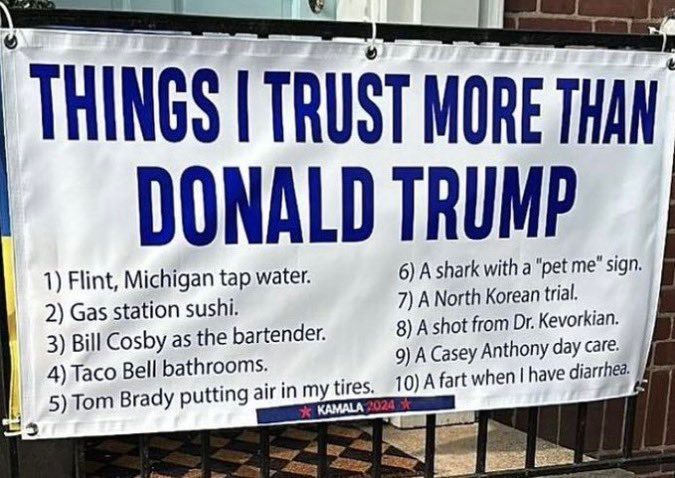
Trump’s use of numbers isn’t just dishonest— it’s corrosive. It erodes the very idea that facts matter, that policy should be rooted in reality, and that leadership should come with accountability. When he throws out fake statistics with the confidence of a seasoned grifter, he’s not trying to persuade skeptical voters— he’s reinforcing the belief among his followers that truth itself is negotiable, and that he alone defines it.
In this way, his lies aren’t merely individual falsehoods. They are building blocks in a parallel reality, designed to shut down debate, confuse the public and inoculate himself from criticism. He doesn’t want people to question what they hear; he wants them to feel it. The bigger and bolder the number, the more emotional the reaction— and the less room there is for fact-checking or critical thought.
As we head into another election, this matters. Because Trump is once again asking for power— not to govern, but to dominate the narrative. If his party controls Congress again, it won’t be with a mandate of truth, but with a mandate of delusion, built on numbers that don’t add up and promises that collapse on contact with reality. In a functioning democracy, we don’t just elect leaders— we choose which version of reality we’re going to live in. The question in 2026 isn’t just whether we can survive another Republican Congress with all that that means— surviving another presidency where lies aren’t mistakes but the governing philosophy.


Comments