


Dissent and AI: The Future Is Clear


By Thomas Neuburger
From roughly a dozen angles, we can see a specific and dangerous future emerging. That future includes widespread AI domestic surveillance married to politics-based dissent repression or punishment, all under a bipartisan flag.
Let’s look at this story from just two of its many angles, the war on domestic dissent and the AI incursion into American lives.
The War on ‘Anti-American’ Dissent
The attack on dissent is bipartisan. Let’s choose just two of the most recent participants, Biden and Trump.
Biden’s Attack on Dissent
Most don’t remember or probably failed to notice Joe Biden’s DNI document “Domestic Violent Extremism Poses Heightened Threat in 2021,” which contained this handy definition of one class of violent extremists:

This definition was later encoded in Biden’s “National Strategy for Countering Domestic Terrorism” from later that same year.
For Biden this security posture was justified, to the public at least, by its seeming attack against “bias related to religion, gender, or sexual orientation” (see column 3 above) and its inclusion of right-wing extremists in the DVE definition, a move that, among other things, guarantees acceptance from most of the Democratic voting base.
But don’t be confused: Under Biden and that side of the fence, if you’re opposed to capitalism, corporate globalization (which includes most corporations), or our “governing institutions” (including the FBI and CIA), you’re a potential violent extremist.
And part of the government’s solution? Finding out which individuals “require, for the safety of others, additional scrutiny.” Whatever that means.
Trump’s Attack on Dissent
Now comes Donald Trump and his own security declaration, the “United States Counterterrorism Strategy”. The enemies now include those opposed to Christians and conservatives (“Americans have witnessed the politically motivated killings of Christians and conservatives committed by violent left-wing extremists, including the assassination of Charlie Kirk by a radical who espoused extreme transgender ideologies”), and noticeably absent are references to right-wing militias and self-styled “sovereign citizens.”
But in both documents, the “left” is still front and center. As Ken Klippenstein puts it:
The White House declared war on the American people today, labeling its political opponents as terrorists, including “Left-wing extremists.” The new label also claims that there are “deepening alliances” between “the far-left and Islamists” — or pro-Palestinian protesters.
The tools include surveillance and what Trump’s document calls crippling enforcement:

This is a fascist wet dream. Both documents are. And no matter who runs things, it’s coming, if not almost here. Palantir’s the new golden boy, a bipartisan choice, and Palantir wants its enemies to “wake up scared.” Guess who those enemies are.
AI Sneaks Into Chrome
At the other end of the spectrum, at the seemingly-innocent consumer end, is corporate infestation of your (or “your”) computer with AI helpers and watchers. Case in point, Google Chrome.
This information comes from many sources. This is from Twitter, with a good explanation of how to deal with the problem.
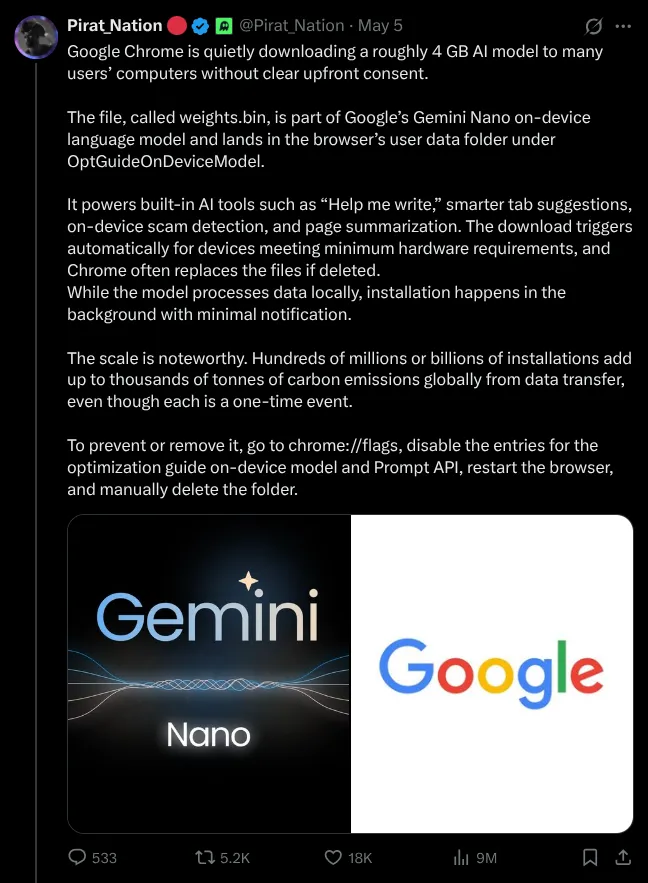
The comment thread contains his handy view of those troublesome Chrome settings entries:

Even if you don’t find the file “weights.bin” anywhere in your system (do a global search just to be sure), you should change all the flagged settings shown above from whatever they were to “Disabled”. That’s the only permanent way to turn this thing off and keep it from turning back on. For now.
Why Should I Not Have AI on My Computer?
In general, AI on computers is spyware. It watches everything you do in order to “help you work better.” Most people like the “help you work better” part and thus never give thought to how much access the AI has to have in order to do it.
Read the image above. The first two settings enable the Prompt. The next three interact with your writing and reading. Does Gemini interact with only the material you give it? Or is Gemini “always on,” always reading, ready to help you faster with whatever you’re doing?
Even if it’s not always on, the whole operation was enabled without your knowledge and clear upfront consent. Why would Google do that if not to prevent opting out?
Remember: Even if Google’s “we’re just being helpful” explanations are valid today, they may not always be valid. Google can change its mind whenever it wants. It says so in the settings above:
The API may be subject to changes including the supported options.
That’s probably all the warning you’re going to get, the one you’ve already had, buried in a settings page almost no one will read.
A Permanent Open Mic
As an example of “always on” mics, consider your phone and the handy “Hey Google” voice prompt. When this service, called Google Assistant, is enabled, it has to be always listening, right? If it isn’t, how can it respond?
Thus turning the Assistant on, turns your phone into an open mic, with Alphabet Inc. at the listening and storage end. Listening and storage. With the data available to whom? Everyone in the country who has control of your lives: corporations, Palantir, and their partners, the security state.
Do you care? That’s up to you. But the wave of internal surveillance is not receding. Would a pernicious state actor — our terrorist-frightened state has many of those — actually go too far, actually use the data its partners collect, to maintain the power and place of those in control?
If you think it wouldn’t, you’re wrong. That ship has sailed.
the USA PATRIOT Act has generated a huge amount of debate and controversy since its approval by President George W. Bush in October 2001. Signed into law with little debate or congressional review just 43 days after the September 11 attacks, the act’s provisions enable the government, with permission from a special court, to obtain roving wiretaps over multiple communication devices, seize suspects’ records without their knowledge, monitor an individual’s web surfing and library records, and conduct surveillance on a person deemed to be suspicious but without known ties to a terrorist group. [emphasis added]
And once given, the power of the security state was used almost immediately for non-security ends and political gain:
That’s from May 2003, a year and a half after the Patriot Act was enacted. The acts’s been renewed at every opportunity since, and with full bipartisan consent. No one wants to surrender the power it confers.
“End of,” as the Brits like to say. The future is now.



I like games that are easy to understand but difficult to master. eggy car definitely fits that style.
They're turning technology into a joke and a mess with AI the GOP thinks they're clearly tech experts which they're certainly not.