


What Is This ‘Deficit’ We Hear So Much About?


By Thomas Neuburger
Doctor 1: You mean there was no deep fat? No steak or cream pies or hot fudge? Doctor 2: Those were thought to be unhealthy. Precisely the opposite of what we now know to be true. —From Sleeper, a comedy set in the year 2173
This is Part 3 of a short series on money. We started here with a look at what dollars are. There we uncovered the most basic fact about dollars, obvious yet never ever acknowledged:
• You can’t make dollars. Only the government does that.
Totally obvious, right? Can you print money? No. Can the government? Yes. In fact, every dollar you own came from the government. If the government never made dollars, you would have none, since no dollars would ever exist.
Let that sink in. It’s both obvious and hard to believe, because the implications change black into white, reverse what you think — and more, reverse what those who run government want you to think.
The lie: The federal government is spending your money, “your tax dollars.”
The truth: All of your dollars come from the U.S. government. The deceptively named “deficit” is no deficit at all. It’s a surplus. It’s money for you.
Back to the Start
Let’s go back to the start of a country like ours, a country that makes its own money. This imagined government is new, so no one who lives there has dollars.
How to fix that? Easy. The government spends; it buys things. Dollars go out to the public, goods and services come back, and people have money to purchase things for themselves.
So is government spending a debt? Of course it’s not. Government spending is a trade; it puts something out, gets something back, and we get dollars to use. Good for us! The economy now works.
Every Government Dollar Goes To Somebody’s Pocket
Here’s the truth: Every “deficit” dollar is not a debt — it’s a dollar we own. Here’s a picture of the U.S. economy from 1952 to 2020:
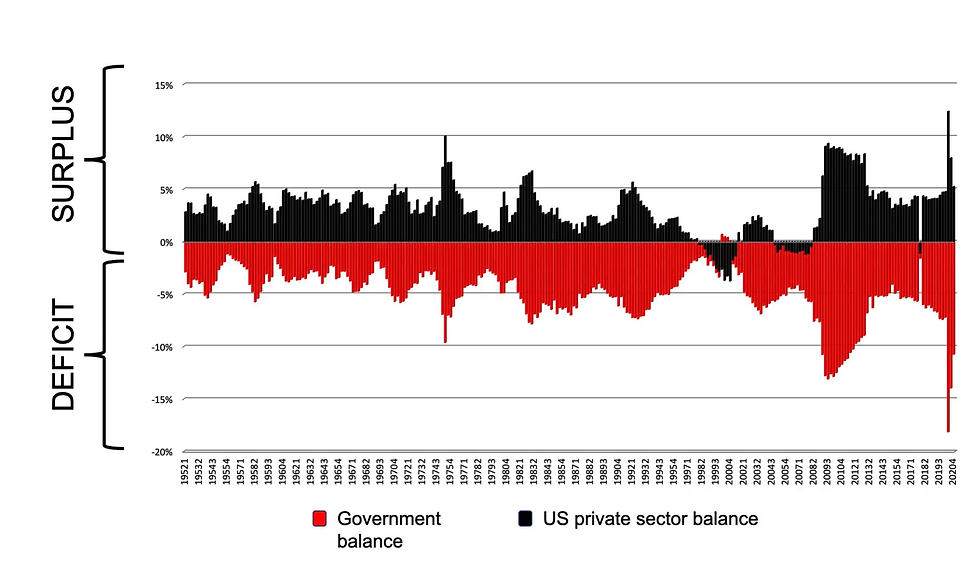
The bottom-half lines show the deceptively-named “deficit.” Again, this is not money owed; it’s just money being spent. The top-half lines show money in circulation — new money we have thanks to new government purchases.
• The “deficit” isn’t a debt; it’s a gift to consumers.
To see the full story, watch this video. It’s short and clear.
So What’s the Bond Market?
If the “deficit” isn’t a debt, then what’s the bond market? That’s an excellent question. The bond market’s totally optional, not needed at all. It’s another gift to consumers, mainly the rich. It’s just a place to park money.
Curious? Stay tuned for Part 4. You’re in for a treat.



The claim that every deficit dollar is simply a dollar we own is striking, but it seems to skip over what happens when government spending outpaces real productive capacity. If dollars are created through spending, doesn't the effect depend heavily on where that spending lands and whether the economy has slack? I'd be curious how the author distinguishes useful deficit spending from spending that mainly inflates asset prices rather than broadening real purchasing power.
Further reading: https://worksheetgenerator.org/
El contenido presenta el tema de forma natural y fácil de seguir. Para quienes consultan loteria nacional, contar con datos bien explicados puede hacer más sencilla la búsqueda de resultados.
When it comes to Deficit's & The Economy leave it to The GOP and whoever their candidate is running for President to screw everything up.
This is a useful topic for anyone trying to understand how a deficit works and why it matters in everyday economic discussions. Breaking down complex financial concepts in simple terms can make these issues much easier to follow. On a different note, a meaningful gift such as a Hanuman idol can be a thoughtful choice for special occasions.
This article provides a helpful explanation of what a deficit means and why it matters when discussing weight management, calorie intake, and healthy lifestyle goals. Understanding concepts like calorie deficit, energy balance, metabolism, portion control, nutrition, and daily calorie needs can make health information easier to follow. I also appreciate the reminder that sustainable results usually come from realistic habits rather than extreme approaches. Alongside balanced nutrition and regular physical activity, exploring evidence-informed Natural Remedies can be part of a broader wellness routine. Overall, this is an informative resource for anyone trying to understand healthy weight management and make more informed everyday health choices.