


The Jester And The Plague: How Authoritarianism Seduces The Comfortable... Is That You?

Nothing Can Be Done? We Need To Decide If We'll Be Like Pabst Or Mann

Last month, The Atlantic held onto published a piece by Gal Beckerman, that I’ve had on my desktop ever since, Why Do Collaborators Do It? It offers a rich framework for analyzing complicity and moral erosion in Trump’s America, especially as we navigate the metastasizing authoritarianism and normalization of cruelty that’s taken root in large parts of the political and cultural landscape— not to mention the regime’s bullying of the media as see, most recently, by the GOP defunding PBS and NPR, by last week’s pressure on CBS to dump Colbert and by the massive lawsuit against the Wall Street Journal. I knew sooner of later we’d have an opportunity to apply novelist Daniel Kehlmann’s moral gray zones and slow descent into collaboration during the Hitler era to what we're witnessing today in our own country.
“The idea,” wrote Beckerman, “that complicity is not a line that one jumps across, but rather an accumulation of rationalizations, fascinates Kehlmann: the wishful thinking that the threat is sure to end soon; the worries about how best to keep one’s children safe; the need to continue working; the self-protective modesty of telling oneself, What difference could I possibly make? Yet whenever he considered depicting the Nazi period, he was deterred by the limitations of conventional storytelling: The ‘easy way of writing about victims— they’re in a terrible situation, and bad stuff happens to them, and then they either escape or they don’t’— struck him as boring, especially given the firsthand family memories he’d grown up with as the son of a Jewish father who had survived the war years in Vienna. What seemed far more interesting was the question of what happens in the gray zone between victim and perpetrator.”

In Daniel Kehlmann’s haunting novel The Director, a fictionalized account of filmmaker G. W. Pabst’s quiet collaboration with the Nazi regime, complicity is a process, not an act isn’t an act. It happens slowly, step by rationalized step, in the spaces where fear, ambition, and self-deception nestle in. No one, certainly not Pabst, starts out intending to help a dictatorship along. They simply don't stop it.
Kehlmann’s Pabst doesn’t give speeches for Hitler. He doesn’t beat prisoners or sign loyalty oaths. He just keeps making films. He convinces himself that art is neutral. Beckerman wrote that “The gaps in Pabst’s story provided Kehlmann with the chance to ask a compelling question. Great art might warrant ‘moral compromise,’ he told me. ‘But how far do you go?’ He tells himself that he didn’t ask for the prisoners being used as extras. He assures his conscience that no one is really being harmed. And even when the hollow eyes of concentration camp victims stare back at him from the set, his response is silence, followed by a quiet, soul-crushing concession: “I guess not.”
This is the moral architecture of collaboration— not grand betrayal, but small resignations. And if it sounds familiar, that’s because we are watching a version of it play out right now. Every autocratic movement needs its monsters— a Stephen Miller and Kristi Noem here, MAGA Mike Johnson and Pam Bondi there… Tom Homan, Tommy Tuberville, JD Vance, Russell Vought, Pete Hegseth, Elon Musk, Susie Wiles, Greg Abbott, Ron DeSantis, Karoline Leavitt, RFK, Jr, Tulsi Gabbard, Peter Navarro. But to succeed, it also needs its Pabsts—those who will normalize, explain away, accommodate. In Trump’s America, there’s no shortage. How many Marco Rubios are there? How many Mike Lawlers, Scott Bessents, Pete Ricketts, Ted Budds and Bernie Morenos?
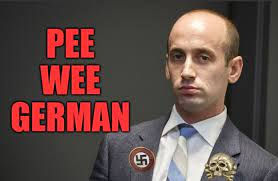
There’s the Supreme Court justices dining at donor-funded retreats while dismantling democratic protections. The tech CEOs smiling for the camera after private meetings with Trump because they still want access to the levers of influence. The Republican governors, beyond Abbott and DeSantis, who parrot his talking points about election fraud— not because they believe them, but because they’ve calculated that silence is politically riskier.
There’s the TV anchor who swallows his doubts and reads the script. The college president who fires the professor to avoid a controversy. The corporate lobbyist who funds the architect of family separation but posts “Love is Love” during Pride. The donor who sees where all this is going but still writes the check, just in case another MAGAt wins again and they need a seat at the table.
These are not on the same level of monstrousness as Stephen Miller and Russell Vought. They are not even radicals. Most of them are respectable, educated, credentialed. Like Pabst, they probably tell themselves they’re just trying to survive, to keep doing what they love, to make the best of a bad situation… maybe even to serve the country and keep it from getting worse than it could be. But the consequence is the same: one moral compromise after another, until they are helping a regime consolidate its grip on power… and doing so with a straight face.
Kehlmann’s fictional Paracelsus contains a surreal scene in which a jester— representing the plague— dances madly, leading townspeople into a frenzy of entranced self-destruction. It’s meant to be grotesque, satirical and horrifying all at once. Watching the film, you can’t help but think: this is Trump.
In the end, he’s a jester too, no? But he is also the plague. He infects everything he touches with shamelessness and absurdity. Señor TACO’s charisma is toxic, his buffoonery disarming. And like Kehlmann’s townspeople, much of the country has been dancing along.
The media, ever hungry for ratings, played their role early— turning every lie into a news cycle, every threat into a spectacle. Institutions folded themselves into knots trying to “normalize” his presidency, as though they could contain a pathogen by appeasing it. Even now, with his plans for mass deportations, sweeping crackdowns and open retribution laid bare, too many people are still dancing to the beat of inevitability. I guess we’re not yet a full-blown dictatorship. But the conditions— erosion of norms, acceptance of cruelty, elite compliance— are spreading. How will will know when we’re there?
When Pabst’s assistant, Franz Wilzek, shrugs at those gaunt prisoners from a concentration camp on his film set and says: “Nothing can be done. We didn’t make it happen. We can’t keep it from happening. It has nothing to do with us” … that line should chill every one of us. It echoes through every bureaucratic excuse for cruelty, every politician’s dodge, every bystander’s silence. It’s the shrug of the TSA agent patting down a sobbing child. It’s the ICE officer saying, “I’m just following orders.” It’s the executive saying, “This isn’t personal. It’s just business.” It’s the language of collaboration dressed up as detachment.
But, guess what— complicity is never neutral. It’s cumulative. It begins with small decisions that feel manageable, and ends with atrocities that feel inevitable. And the longer we tell ourselves “it has nothing to do with us,” the harder it becomes to draw a line, to say no, to opt out of the slow descent.
What Kehlmann captures so powerfully in The Director is the quiet seduction of authoritarianism— not just its brute force, but the ways in which otherwise “decent people” drift into collaboration through small accommodations, professional ambitions, or the belief that they can “stay above it all.” It’s not a leap into darkness; it’s a shuffle. And that’s exactly what we see happening around us today, albeit not in Germany or Italy.
Every one of the MAGA enablers has their own story, and almost all of them resemble Pabst far more than Riefenstahl. There are relatively few out-and-proud monsters in Trumpworld. What we get instead are the Pabsts— people who never quite say yes to evil, but never say no either. They tell themselves they’re just playing the game, just trying to get through the storm, just doing their jobs. From White House aides who ghostwrite Trump’s speeches to Republican senators who tut-tut his behavior privately but vote with him publicly, to CEOs who attend his fundraisers because “you can’t afford to be on the wrong side”… they’re all figures in the tragic pantomime of complicity.
Kehlmann contrasts Pabst with another German artist: Thomas Mann. Mann didn’t return to Germany during the Nazi years. He didn’t take a paycheck, didn’t say, “Maybe I can still make good art.” He said, simply: “I cannot return to Germany until justice and freedom have preceded me there.”
That’s the standard. Not clever ambiguity. Not plausible deniability. Not aesthetic detachment. A line. A refusal. A voice that says, “This is wrong, and I will not be a part of it.”
There are still opportunities for that kind of courage in Trump’s America. For judges, politicians, donors, journalists, educators, citizens. If I lived in Kentucky, in Kenton, Boone, Campbell Oldham, Shelby, Greenup County, I’d be switching my registration now so I could vote for Trump antagonist Thomas Massie in next year’s GOP primary. But time is running out. The jester is dancing. The plague is spreading. The extras are on the set, and the camera is rolling. The question isn’t what you’ll do if the worst happens. The question is what you’re doing now. Because the real danger isn’t choosing evil. It’s believing that not choosing is somehow safe.




Comments